Vibratory sieve price: what decides the cost
We do not publish a price list, because the price follows the configuration. These are the factors that set it:
- Machine type and size: a round vibratory sieve is priced by diameter; a mining screen by screen area. Bigger means more steel and a larger drive.
- Number of decks: each extra deck adds a frame, a screen and more output spouts.
- Mesh and screen media: fine stainless mesh, polyurethane panels and perforated plate differ in cost and wear life.
- Contact material: carbon steel, or stainless steel on the parts that touch the product.
- Drive: vibration motor rating, voltage and frequency for your country, and any special enclosure.
- Options: mesh cleaning (for example bouncing balls), dust covers, spray bars for wet screening, stands and chutes.
- Quantity, packing and destination: number of units, export packing and delivery terms.
What to send for a quotation
- Material, and whether it is dry powder, granules or slurry
- Capacity (t/h)
- Mesh or cut size, and number of product sizes
- Contact material required
- Destination country and supply voltage
Get a factory quotation by email WhatsApp
We email a quotation, usually within 24 hours. Prices are not published.
Full guide: Vibrating screen and sieve price guide
What is a vibratory sieve for ceramic glaze?
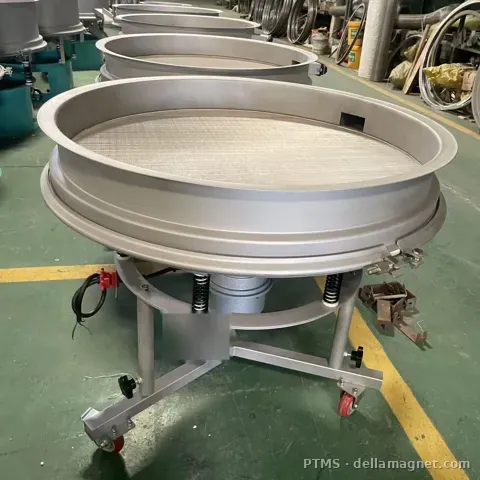
It is a round, high-speed vibratory sieve that screens ceramic glaze just before application, removing lumps, grit and foreign particles. This PTMS-G1200 uses a 3000 rpm, 1.1 kW vibration motor and a Φ1130 mm screen, and it can stand on a fixed base or on a wheeled stainless stand that moves between glaze tanks.
How does a glaze sieve work?
The vibration motor shakes the screen frame on its springs, so glaze poured onto the mesh spreads out and passes through while oversize particles stay on top. The mesh is chosen to the fineness of your glaze when you order.
Vibrating screen vs vibratory sieve: what is the difference?
“Vibratory sieve” is the usual name in glaze shops for this round, motor-vibrated machine; “vibrating screen” is a wider term that in mining refers to large linear or circular ore screens. For body slip, see the vibratory sieve for ceramic slurry; for dry powders and granules, the three-deck PTMS-1200-3S (powtechina.com).
Where does it sit on a glaze line?
Just before glazing. Because the sieve separates by size only, the fine iron that fires into black specks is removed by a glaze magnetic separator: see ceramic glaze magnetic separators (powtechina.com).
Glaze sieve: frequently asked questions
What is the difference between a vibrating screen and a vibratory sieve?
“Vibratory sieve” (vibro sieve) usually means a round, motor-vibrated sieve for fine powders, slurries and glaze; “vibrating screen” is broader and in mining usually means large linear or circular screens for sizing ore. This Φ1200 unit is a vibratory sieve for ceramic glaze.
Does a glaze sieve remove iron?
No. It only separates by size; fine iron passes through the mesh, so a glaze magnetic separator is installed after the sieve.
Which mesh is used for glaze?
The screen mesh is selected to your glaze fineness when you order.
Can the sieve move between glaze tanks?
Yes. It can be supplied on a mobile wheeled stainless stand, or on a fixed base.
What is the price of a glaze sieve in India?
It depends on diameter, number of decks, mesh, contact material and motor. We do not publish prices; send your glaze, capacity and mesh size for a factory quotation by email.
 PTMS · Della Magnet